
Sponges: They are Nothing Like Sponge Bob!
Amazing Fact: Sponges can filter particles as small as bacteria! Although they may look plant-like, sponges are actually the simplest of multi-cellular animals. These incredible filter feeders are among the ocean’s most effective cleaners, and they’re nothing like SpongeBob
What Are Sponges?
A sponge is a bottom-dwelling creature which attaches itself to something solid in a place where it can, hopefully, receive enough food to grow. The scientific term for sponges is Porifera which literally means “pore-bearing.”
A sponge is covered with tiny pores, called ostia, which lead internally to a system of canals and eventually out to one or more larger holes, called oscula.
How Sponges Work

Water Pumping System
Within the canals of the sponge, chambers are lined with specialized cells called choanocytes, or collar cells. The collar cells have a sticky, funnel-shaped collar and a hairlike whip, called a flagellum.
Sponge Facts
Ancient Design
Among Earth’s oldest animals
Porifera
Literally means “pore-bearing”
Filter Bacteria
Can capture particles as small as bacteria
Hermaphroditic
Have both sexes, can switch roles
Person-Sized
Barrel sponges can fit a whole person!
Rainbow Colors
Tube sponges come in every color
Sponge Gallery
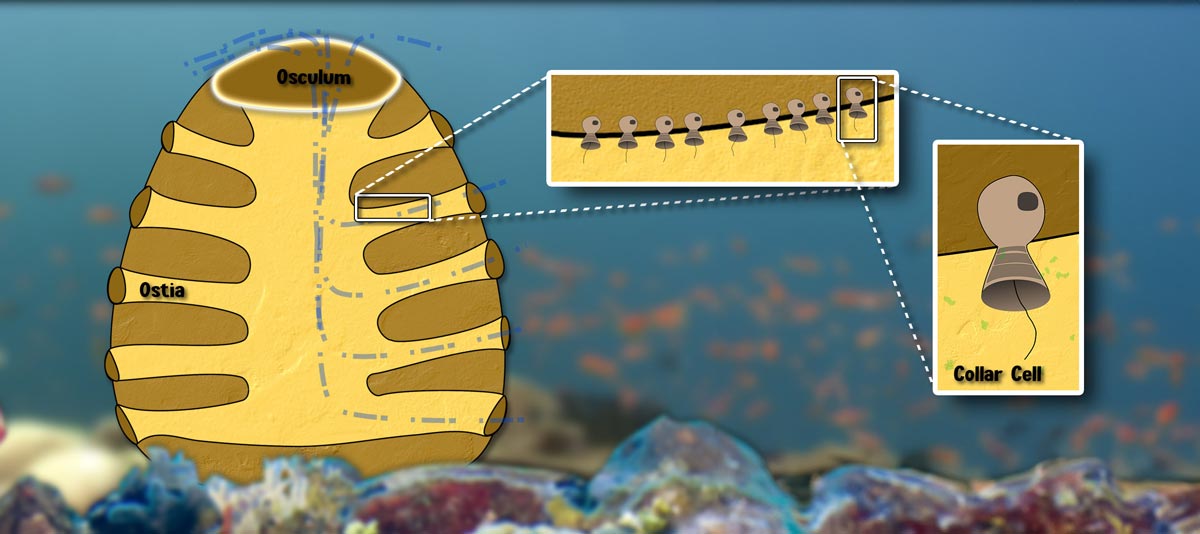
Diagram of a simple sponge
Diagram of a simple sponge
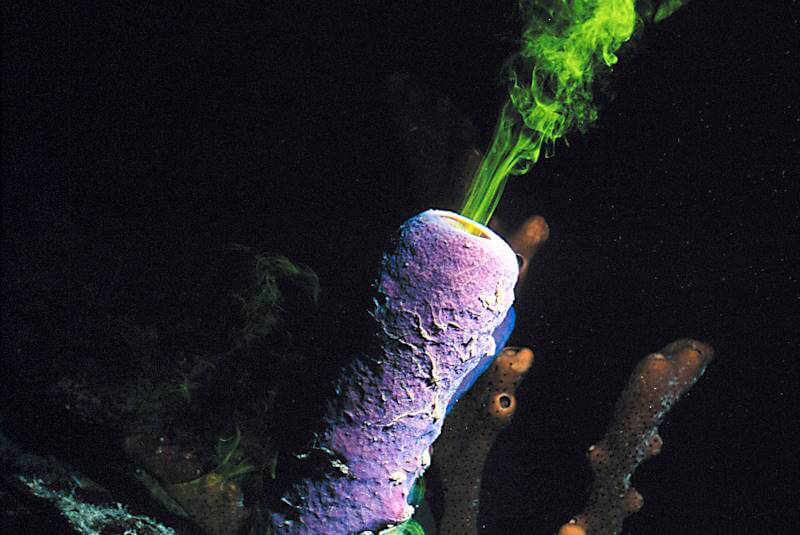
In this photograph, the pumping action of a sponge is illustrated. A non-toxic yellow dye has been squirted around the base of a purple tube sponge in the Caribbean. Shortly thereafter, the dye is pumped out through the osculum at the top of the sponge.
In this photograph, the pumping action of a sponge is illustrated. A non-toxic yellow dye has been squirted around the base of a purple tube sponge in the Caribbean. Shortly thereafter, the dye is pumped out through the osculum at the top of the sponge.
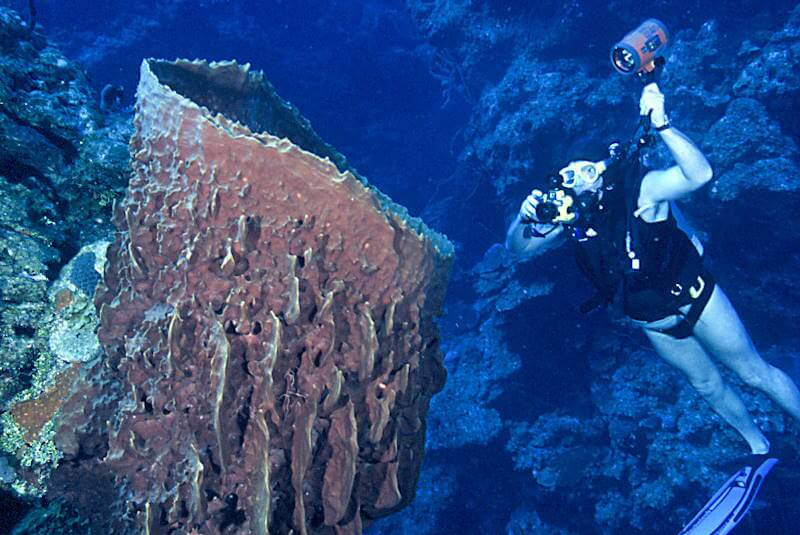
Some sponges grow quite large. This barrel sponge is nearly large enough for the diver to climb right inside! Other barrel sponges get even bigger than this.
Some sponges grow quite large. This barrel sponge is nearly large enough for the diver to climb right inside! Other barrel sponges get even bigger than this.
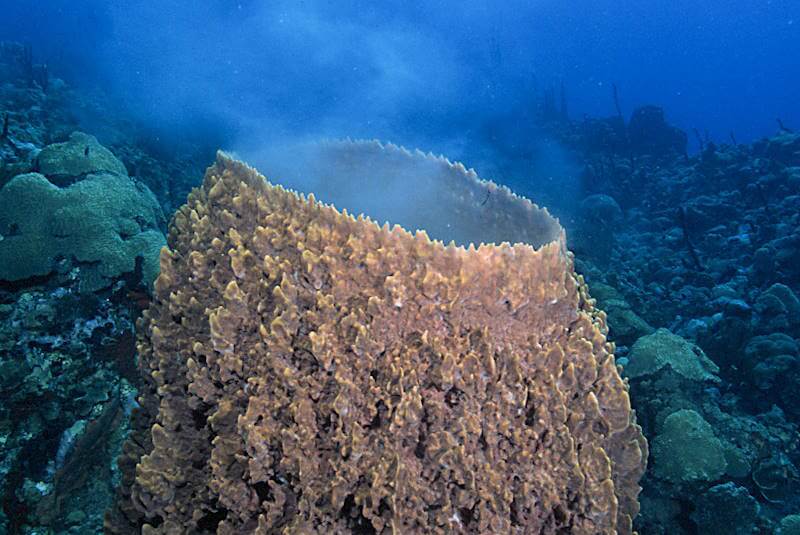
This barrel sponge is spawning.
This barrel sponge is spawning.
Sponge Skeleton
The “skeleton” of the sponge is composed of tiny needle-like splinters called spicules, a mesh of protein called spongin, or a combination of both.
Many sponges can only be identified by microscopic examination of the skeleton, which makes certain identification from photographs difficult.
Reproduction

Hermaphroditic Reproduction
Most sponges are hermaphroditic (having both sexes in one), but produce only one type of gamete per spawn. In other words, some play the male role and others play the female role, even though they are both capable of playing either role.
Types of Sponges
There are many different types of sponges in the world’s oceans, and, contrary to popular belief, they can be quite colorful and beautiful. Sponges come in two basic types: encrusting or free-standing. Although neither of these names are part of the true classification of sponges, it does make it a bit easier to organize them.
Encrusting Sponges
Encrusting sponges typically cover the surface of a rock in the same manner that moss covers a rock on land. These sponges spread flat across surfaces, conforming to the substrate.
Free-Standing Sponges
Free-standing sponges are a bit more interesting. These sponges have more inner volume compared with their outside surface area and sometimes grow into strange shapes, often reaching gigantic proportions.
Many of the free-standing sponges are well known to most people. For example, nearly everyone has heard of the barrel sponge, a large tropical sponge which sometimes grows large enough to fit a whole person inside!
Equally well known are the tube sponges of the tropics, coming in nearly every color of the rainbow.
Colorful & Diverse: While not all sponges are as colorful or as large as those found in the tropics, sponges are an ancient and efficient design which will probably continue to populate the world’s oceans longer than people will populate the Earth.
Sponges in Action
The pumping action of a sponge can be demonstrated using a non-toxic yellow dye squirted around the base of a purple tube sponge. Shortly thereafter, the dye is pumped out through the osculum at the top of the sponge, showing how efficiently sponges filter water!
Sponge Facts
Ancient Design
Among Earth’s oldest animals
Porifera
Literally means “pore-bearing”
Filter Bacteria
Can capture particles as small as bacteria
Hermaphroditic
Have both sexes, can switch roles
Person-Sized
Barrel sponges can fit a whole person!
Rainbow Colors
Tube sponges come in every color
Sponge Gallery
Diagram of a simple sponge
Diagram of a simple sponge
In this photograph, the pumping action of a sponge is illustrated. A non-toxic yellow dye has been squirted around the base of a purple tube sponge in the Caribbean. Shortly thereafter, the dye is pumped out through the osculum at the top of the sponge.
In this photograph, the pumping action of a sponge is illustrated. A non-toxic yellow dye has been squirted around the base of a purple tube sponge in the Caribbean. Shortly thereafter, the dye is pumped out through the osculum at the top of the sponge.
Some sponges grow quite large. This barrel sponge is nearly large enough for the diver to climb right inside! Other barrel sponges get even bigger than this.
Some sponges grow quite large. This barrel sponge is nearly large enough for the diver to climb right inside! Other barrel sponges get even bigger than this.
This barrel sponge is spawning.
This barrel sponge is spawning.
Explore More Wonders
Sharks
Coral Reefs
Echinoderms
Cnidarians
Mollusks
Sperm Whales
Chessie
Mangroves
Arthropods